Tag: Counseling

What to Expect When Your Teen is in Therapy

What to Expect When Your Teen is in Therapy

It’s very common for parents to feel lost when it comes to dealing with the challenges of parenting a teen. If these challenges become too much for your teenager, and you feel you need additional support to help them, therapy may be a wise option.  

What Have You Found Out About Yourself and Your Life During COVID-19?

What Have You Found Out About Yourself and Your Life During COVID-19?

We’ve all been through some significant life adjustments in the months of quarantine. Some of them difficult to assimilate. And, there might be a couple that you found might suit you. No matter where you are in your stance toward the pandemic, the reality is 

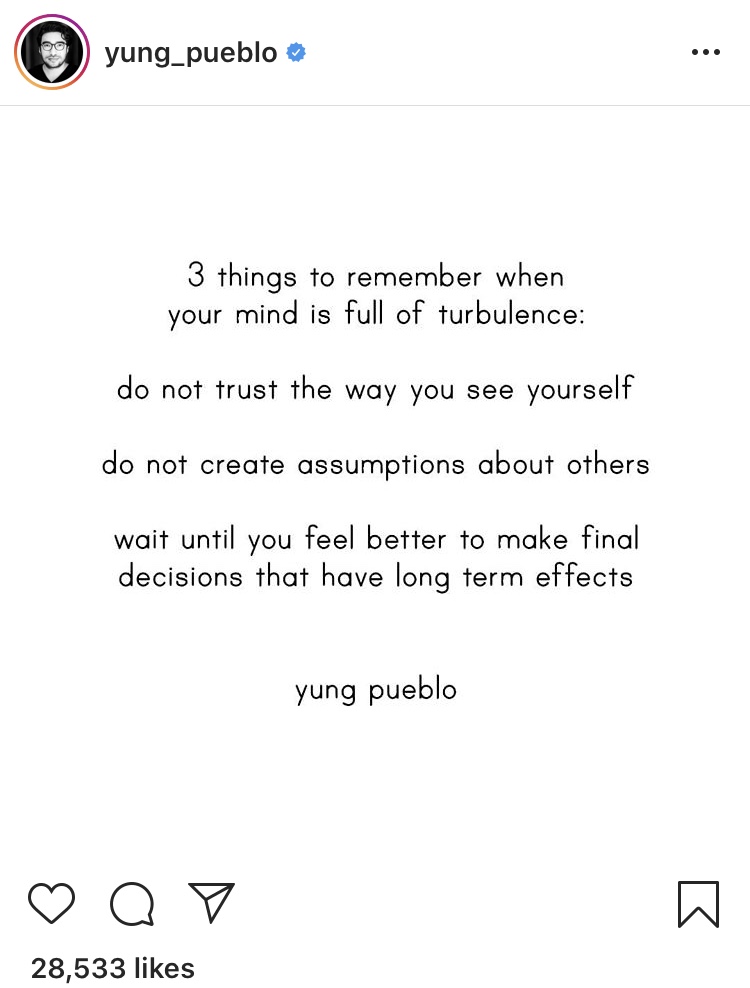
5 Instagram Accounts That Can Support Your Growth (and help detox your feed)

5 Instagram Accounts That Can Support Your Growth (and help detox your feed)

There are some great Instagram accounts out there that break down old ways of thinking and teach according to current concepts and findings in the psychology world.

I love how these therapists, coaches and teachers are able to capture complex concepts and put them into digestible infographics or quotes.

Following accounts like these are a great way to keep helpful thinking front and center, learn about yourself and support the work you are doing in therapy.

Check these out:

@the.holistic.psychologist

@young_pueblo

@sitwithwhit

@somaticexperiencingint

@theselflovefix

Do you have any favorite accounts that support your mental health?

How Are You Holding Up?

powered by Typeform

5 Ways To Balance Out Fear Coming Up Around the Coronavirus

5 Ways To Balance Out Fear Coming Up Around the Coronavirus

There are a few basic emotional intelligence concepts coming up that can be helpful as we navigate this territory of the Coronavirus. Let’s lay the groundwork with those. Then, we can talk about 5 helpful thoughts that we can incorporate to how we are thinking 

How Often Should I Go To Therapy?

How Often Should I Go To Therapy?

Aside from “how long does therapy take?”, which was discussed last week, another common question is “how often should I be seeing my therapist?”

Again, it depends. So let’s talk about that.

What follows applies to those who are coming in for individual, family, couples, child or adolescent therapy.

In the Beginning

We recommend doing weekly sessions for 4-6 weeks regardless of whether you are being proactive or working on a specific challenge. If you are in crisis, you may need multiple sessions a week in order to stabilize the situation.

We recommend having those first 4-6 weekly sessions because two important things are happening.

One is you are getting to know your therapist, seeing how they work and how comfortable you feel working with them. You are sorting out if you can trust the guidance and insights that your therapist brings forward, if you find their responses and way of working helpful to you. If that trust is not there, you are not going to get the return on investment.

Second, your therapist is finding out all about you and what is bringing you to therapy. Your therapist is gathering information about your history, your family, your health, your support network and your current coping strategies through what you say and what you don’t say. Give your therapist the opportunity to do that because they are going to be WAY more effective that way.

Once you have some trust and good rapport built up and your therapist has a solid picture of what is going on with you, you guys can decide together what is going to be best in terms of session frequency.

Weekly Sessions

Weekly sessions are super helpful in the following situations:

  • you are working on building skills (coping, communication, social, mindfulness skills)
  • you are working through a specific challenge that is actively showing up in your daily life (anxiety, relationship difficulties including divorce, grief, behavioral issues, depression, trauma).
  • you are breaking old patterns and reprogramming thinking as well as behaviors because this requires repetition and a neutral party who can consistently support you in seeing how this is showing up in your life as well as how to shift.

Of course, there are other reasons, those are just some basic ones. Weekly sessions are most definitely an investment of your time and resources. And, doing this from the start will actually get you where you want to go faster. Doing biweekly sessions might actually fatigue you and feel like therapy is not working because progress may take longer or just might be more difficult. Better to fully invest and get your work in.

Biweekly Sessions

This is a good option when:

  • You have been in therapy some time and you are seeing progress like less anxiety, alleviated depression, decreased overwhelm, being able to practice the skills you are learning in session out in the real world.
  • You are being proactive about coming to therapy so there is nothing urgent, but you are doing some inner work on yourself and you are doing work between sessions that your therapist suggests or that you find supportive like meditation, journaling, establishing a fitness routine, etc.

As Needed Sessions

This is helpful at the following times:

  • You are a therapy veteran! You have been in therapy for a long time and your therapist knows you well so when something comes up and you schedule a session, your therapist knows how to support you through it. Sometimes people come in for one session, sometimes it’s a series of sessions to deal with a specific challenge.
  • You have an established relationship with a therapist that you created while being proactive. Your therapist is familiar with your history and goals and can be there for you when stuff comes up.

Multiple Sessions in One Week

This is usually indicated when:

  • You are in crisis, which means that your safety is in question or daily functioning is impaired (can’t stop crying, concerns about self harm, can’t go to work or school, etc).
  • You are in the middle of making a big decision or big transition in your life and you need support through that to stay healthy and afloat.

This is by no means a comprehensive list, just something to give you an idea of what to expect as you embark on or during your journey in therapy.

Know that this is an important conversation to bring up periodically with your therapist. We want to be mindful of your time and resources AND we want to make sure that your experience in therapy is effective and productive. Not something that drags on. Or conversely, doesn’t sufficiently address your goals, which then makes therapy less than effective.

Engage in making the decision about how often you come in for sessions together with your therapist, as their clinical recommendation is important to consider.

This Father’s Response to his Daughter’s Feelings Captures the Essence of Emotional Health

This viral video was shared in a group recently and it stopped me in my tracks. Watch what he does in the first video (3 min) and then listen to what he says about that experience in the second video (4 min). And then I’ll 

Fall Check-in and Holiday Preparation

Fall Check-in and Holiday Preparation

A couple of months ago, we wrote a post about the Top 5 Back to School Tips from One Heart Therapists. We thought it would be a good time to check back in about those! And to support you in starting to consider what your 

One Way Conflict Can Be Good News For You Every Time

One Way Conflict Can Be Good News For You Every Time

What if your spouse, loved one, best friend is not the bad guy? What if you aren’t either?

Let’s be honest, sometimes it feels good that the other person is the “bad guy”. Then we get to be right, justified and safe. At the same time, we know that actually isn’t worth much in the long run.

Being right doesn’t win over getting to growing as a person or having a better relationship.

Let’s start with this basic assumption: the people you have in your inner circle (the ones you brought into that space) are not bad people AND they are probably not intentionally trying to hurt you. Can we agree on that?

Yet, uncomfortable situations, hurt feelings, anger, disappointment, frustration, jealousy, irritation, overwhelm, guilt… that kind of hard stuff shows up in your inner circle relationships. Actual emotional health means we have access to navigate the ENTIRE RANGE of human emotion.

So, just because something uncomfortable comes up between you and someone else doesn’t mean that someone is bad. It means, there is a chance to actually grow as people and have a stronger relationship with all the good stuff in there: more trust, love, closeness, vulnerability, fun.

Why? Because we are human beings growing through things. And we pick these inner circle people to grow with through life.

Also important to remember: It takes two to tango. The problem nor the solution are one sided. No matter how justified you feel. We push each other’s buttons, we have complementary “stuff” that we bring up with one another. For the purpose of evolving.

Here’s the game:

STEP ONE:

You and the other person will need to come to an agreement that you are willing to play this game. This is crucial. It won’t work unless you have willingness on both sides. It does require a level of self awareness and ability to communicate as well.

STEP TWO:

When something happens that is painful or uncomfortable, make a commitment to talk about it. Yup, bring it up. You might not be ready to talk about it right then. You might need some time to get clear on your feelings and what came up for you, but make a point to acknowledge it and commit to talking about it together.

STEP THREE:

Do some reflection on what this interaction brought up to the surface for you to be able to see about yourself and how you interact in relationships.

Ask yourself some of these questions:

When else have I felt like this?

What does this remind me of?

How did I contribute to this challenging situation?

Where else do interactions like this come up in my life?

How do I want to show up instead (baby steps are fine!)?

How could I do this differently next time so it is better for me and us?

STEP FOUR:

Realize that it is a gift this is coming up with someone you love and trust. That way you get the chance to ACTUALLY resolve it instead of sending it to the back of the line of repeating patterns that will definitely show up again. And, what I find is that when people actually resolve repeating patterns, what they really want is on the other side. If you can get to this place before you talk about it with your person, you are in a great space that is not emotionally charged to be able to be receptive and collaborative.

STEP FIVE:

Come together with your person and share about what you noticed about yourself, what you got to see in a new light because of the fact that it came up between you, how you see a pattern that is outdated and no longer needed that you are willing to give up to be able to have a better relationship or be a better person. Listen with compassion to what they share.

And, there you go. You are better as a person and your relationship is better. Your conflict did not harm your relationship or waste your time. And no one is the bad guy.

We are not here to make each other happy. We are here to make each other better.

Have you ever been able to have a conversation like this with someone in your life?

How did it turn out?

Resource: The Empowered Family (teaching kids body safety, boundaries and consent)

Resource: The Empowered Family (teaching kids body safety, boundaries and consent)

I was having a conversation at the gym this morning with my running coach about how there has been a change in the last decade related to what people are looking for when they come to therapy. Of course, people contact us when they are